Every team building serious AI agents eventually runs into the same wall.
The model is not the real problem anymore. The real problem is everything around the model.
You need the right system prompt. The right tools. The right orchestration. The right evaluator. The right environment. The right retry logic. The right feedback loop. And then when you move to a new domain—customer support, enterprise ops, internal tools, research workflows—you do it all over again.
That is the hidden tax of modern agents.
This is the idea behind The Last Harness You’ll Ever Build: what if agents could stop relying on humans to handcraft a new harness for every workflow, and instead learn to improve the harness themselves?
That is the real opportunity. Not just smarter agents. Agents that get better at becoming useful.
First: What Even Is a Harness?
A harness is all the stuff that turns a raw model into a working agent.
It is the prompts, tools, memory, execution environment, evaluation logic, and orchestration that make the model actually do something useful in the real world.
The model is the engine. The harness is the whole vehicle.
And right now, most of the hard work in agent building is harness work.
That is why so many agents look impressive in demos but break in production. The hard part is not generating text. The hard part is building the surrounding system that makes the agent reliable, fast, and task-aware.
The Big Shift
Today, harness engineering is mostly manual.
A human watches where the agent fails, tweaks prompts, changes tool descriptions, adds guardrails, rewrites workflows, improves evaluation, and keeps iterating until the thing finally works.
That process can be incredibly effective. But it does not scale.
Every new task becomes a custom engineering project.
The paper proposes a different path: treat harness design itself as something that can be optimized automatically.
Instead of manually tuning the agent forever, let the system run an improvement loop on its own.
The Core Loop
The idea is surprisingly simple.
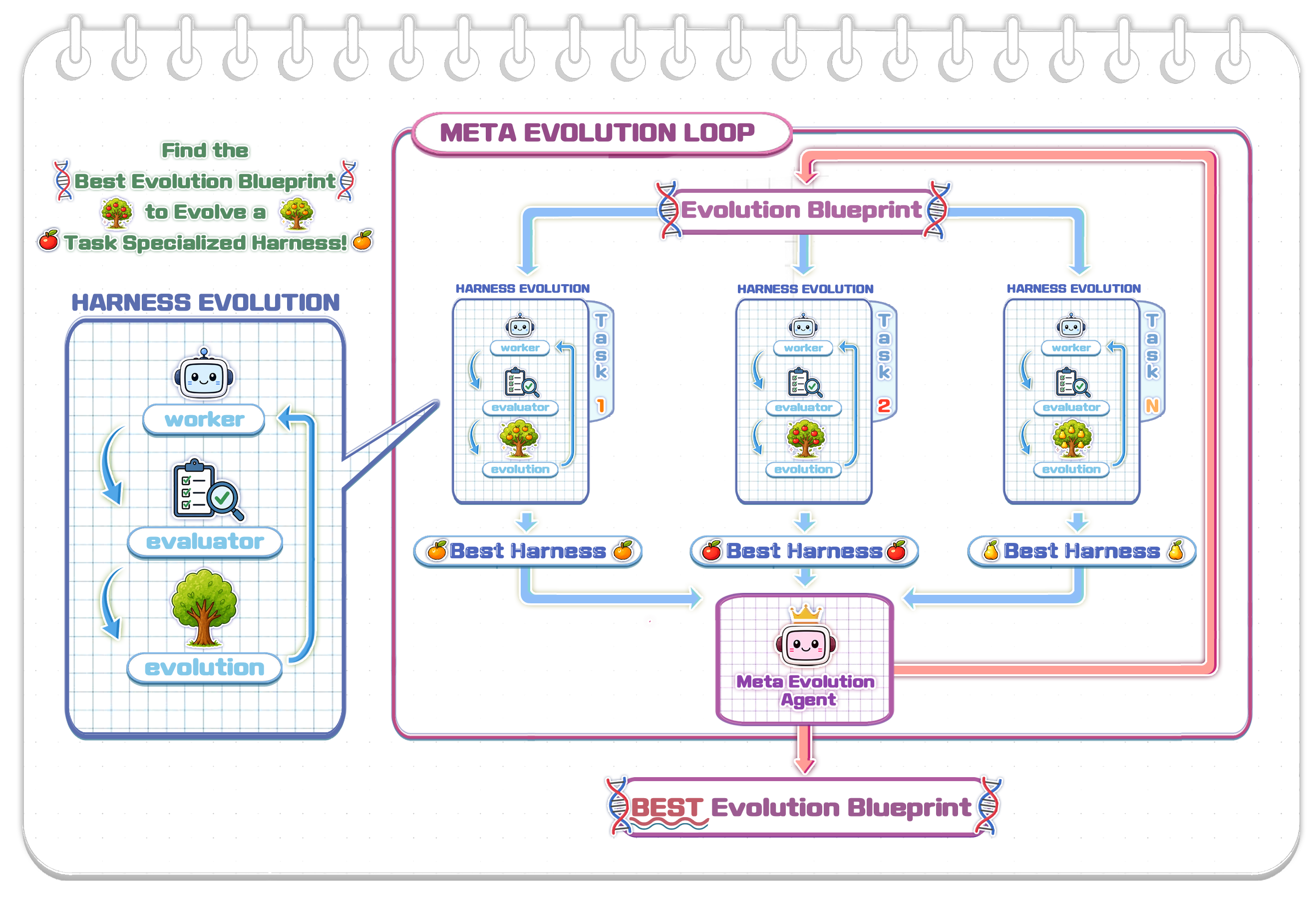
You start with three agents:
- a worker agent that tries to do the task
- an evaluator agent that reviews what happened and scores it
- an evolution agent that updates the harness based on what failed
That creates a closed loop:
- the worker tries the task
- the evaluator finds what went wrong
- the evolution agent changes the harness
- the worker tries again
Over time, the harness improves.
Not just the prompt. The whole harness.
That means the system can evolve:
- prompts
- tool usage
- orchestration logic
- observation structure
- model routing
- other parts of the agent stack that determine performance
This is the part that makes the idea powerful. It is not “prompt optimization.” It is agent optimization at the harness level.
Why the Evaluator Matters So Much
One of the smartest parts of the design is the evaluator.
The worker should not be the one grading itself. That almost always turns into rationalization.
If the same context that picked an approach is also judging the result, the model tends to explain away its mistakes instead of calling them out. It starts defending the attempt instead of evaluating it.
That is why the evaluator needs to be separate, skeptical, and evidence-driven.
Its job is to ask:
- Did the task actually get completed?
- Did the agent really observe what it claimed?
- Which success criteria passed?
- Was the result good, or just confidently wrong?
- Was the agent slow because of the model, or because the workflow was bad?
That separation matters because better criticism leads to better evolution.
The Bigger Idea: Evolving the Evolution Loop
This is where it gets really interesting.
The first loop evolves a harness for one task.
But then the paper asks a more ambitious question:
What if you could also evolve the process that evolves the harness?
In other words, not just:
- “What is the best harness for this task?”
but:
- “What is the best way to improve harnesses across many tasks?”
That second layer is called meta-evolution.
The system looks across many tasks and learns which evolution strategies actually help harnesses improve faster. Over time, it can learn a better blueprint for adaptation itself.
That means the goal is no longer just to build one strong agent.
The goal is to build a system that can take a general agent, drop it into a new domain, and help it become specialized with less and less human intervention.
That is a much bigger deal.
Why This Could Matter
If this works, it changes the economics of agents.
Right now, every serious deployment has a hidden service layer of human harness engineers behind it. Even when people say they have an “autonomous agent,” there is usually a lot of manual iteration holding it together.
An evolving harness changes that story.
Instead of building every agent workflow by hand, you can imagine a future where:
- you define the task
- you define the success criteria
- the system runs
- the harness improves itself
- the agent gets better over time
That is the kind of shift that could make agents far more scalable across messy, domain-specific workflows.
Not just coding. Not just research. Enterprise operations, support flows, internal tooling, compliance tasks, web workflows—anything where the model needs strong scaffolding to perform reliably.
The Real Hype
A lot of the AI world is still focused on making models smarter.
But another path is becoming clearer: make the system around the model smarter.
That is what makes this idea exciting.
The best agent may not be the one with the best base model.
It may be the one that can improve its own harness fastest.
And if that is true, then the future of agents is not just better reasoning.
It is self-improving agent infrastructure.
That is a much bigger story than prompt engineering.
Final Thought
The most interesting part of this paper is not just that it proposes a better way to build agents.
It proposes a world where building the harness stops being a permanent manual bottleneck.
If we get that right, the question changes from:
“How do we engineer the perfect agent for this workflow?”
to:
“How do we let the agent evolve into the right one?”
That is a very different future.
And if it works, it might really be the last harness you ever build.