
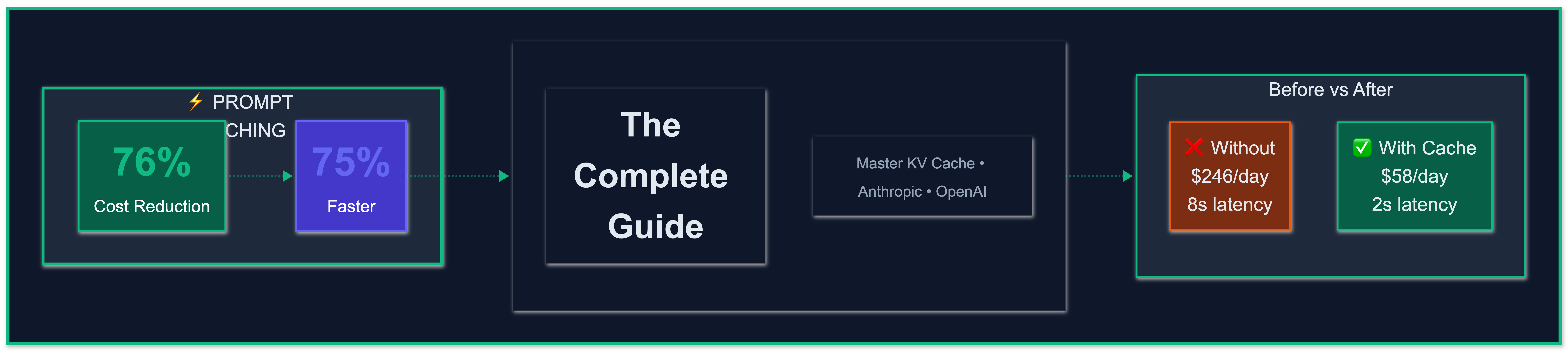
What You'll Learn
- Why LLMs recompute the same tokens repeatedly (and waste money)
- The mathematical foundation: KV cache and attention mechanism
- How to structure prompts for maximum cache hit rates
- Provider-specific strategies (Anthropic, OpenAI)
- Real-world cost savings and performance benchmarks
The Problem
If you're building with LLMs, you've likely noticed a pattern: your application sends similar context repeatedly across requests.
Example: Coding assistant
Request 1:
System prompt: "You are an expert Python developer..." (2000 tokens)
User query: "Write a function to parse JSON" (10 tokens)

Request 2:
System prompt: "You are an expert Python developer..." (same 2000 tokens!)
User query: "Write a function to validate email" (10 tokens)
Without caching, you're paying full price for those 2000 system prompt tokens on every single request.
With prompt caching:
- First request: Pay full price (cache write)
- Subsequent requests: Pay 10% of price (cache read)
- Result: 90% cost reduction + 75% faster responses
The Golden Rule: Static First, Dynamic Last
The key to effective prompt caching is putting static content at the beginning and dynamic content at the end.
✅ Optimal Structure (maximizes cache hits):
┌────────────────────────────────────────┐
│ Static system prompt     (5000 tokens) │ ← Forms cacheable prefix
│ Tool definitions         (3000 tokens) │ ← Extends cacheable prefix
│ Project context          (2000 tokens) │ ← Still cacheable
│ Conversation history     (1000 tokens) │ ← Partially cacheable
│ Current user query         (100 tokens) │ ← Dynamic, not cached
└────────────────────────────────────────┘
Total cacheable: 10,000+ tokens
❌ Bad Structure (breaks caching):
┌────────────────────────────────────────┐
│ Current query              (100 tokens) │ ← Dynamic first!
│ System prompt            (5000 tokens) │ ← Can't cache (no prefix match)
└────────────────────────────────────────┘
Total cacheable: 0 tokens
Provider Comparison
Anthropic:
- Explicit control via API
- ~100% cache hit rate when you ask for it
- Costs 25% more to cache, but saves 90% on cache hits
- Cache lasts 5-10 minutes
OpenAI:
- Automatic (you don't control it)
- ~50% cache hit rate
- Free (built into pricing)
Real-World Example
Coding Assistant: 10,000 requests/day
- Static system prompt: 8,000 tokens
- Average user query: 200 tokens
- Cache hit rate: 90%
Without caching:
- Total: 10,000 × 8,200 = 82M tokens/day
- Cost (Anthropic): 82M × 246/day
With caching:
- Cache writes: 1,000 × 8,000 @ 30
- Cache reads: 9,000 × 8,000 @ 21.60
- Uncached: 10,000 × 200 @ 6
- Total: $57.60/day
Savings: 76% cost reduction + 40-50% faster responses
Best Practices
- Build prompts from static to dynamic:
def build_prompt(system, tools, history, query):
    """Order matters: Static → Dynamic"""
    return "\n\n".join([
        system,           # Layer 1: Static (always cached)
        format_tools(tools),  # Layer 2: Semi-static
        format_history(history),  # Layer 3: Grows over time
        query             # Layer 4: Always unique
    ])
Check minimum size: Most providers require at least 1024 tokens for caching
Monitor performance: Track hit rates and savings in your metrics
Summary
- What's cached: K and V matrices (intermediate calculations in attention)
- Why it works: Linearity of matrix multiplication allows decomposition
- Performance gain: 75% faster, 90% cheaper for cached tokens
- Practical impact: Makes long conversations and repeated prompts much more efficient