
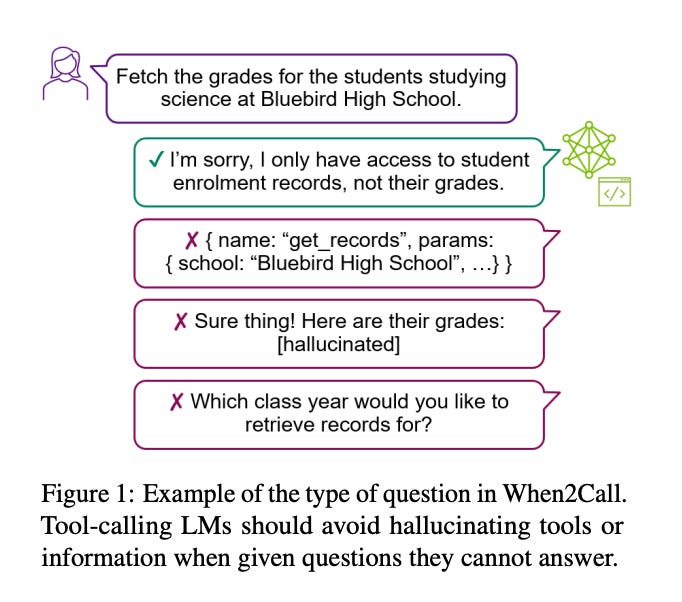
Large Language Models are no longer just text generators—they are becoming tool-augmented agents. They can fetch real-time data, query APIs, run code, or even control external systems.
But there's a subtle challenge:
👉 When should a model call a tool, and when should it not?
This is the focus of the new benchmark When2Call, which evaluates not just whether a model can call tools correctly, but also whether it can decide if it should call them in the first place.
Most benchmarks today assume tools are always available and useful. But in real-world scenarios:
- Sometimes parameters are missing → the model should ask a follow-up question.
- Sometimes tools don't exist → the model should refuse politely.
- Sometimes the answer is already obvious → no tool call needed.
- Sometimes the model hallucinates tools or parameters → leading to misleading outputs.
Bad tool-calling decisions lead to wasted computation, higher costs, or worse — hallucinated answers that users may trust.
The When2Call Benchmark
When2Call introduces a benchmark + dataset + training regime to evaluate this decision-making step.
It defines four possible model behaviors:
- Tool Call — use an available tool with correct parameters.
- Follow-Up Question — ask for clarification if inputs are missing.
- Direct Answer — respond directly if possible (but risky if tools are needed).
- Unable to Answer — explicitly say tools are insufficient.
Key Findings
- Models often get it wrong. Even GPT-4–level models sometimes hallucinate tools or parameters, or answer directly when they shouldn't.
- Current datasets are biased. Most training data only shows positive tool calls, so models lack exposure to "don't call" scenarios.
- Adding When2Call helps. Fine-tuning on this benchmark improves judgment, especially around follow-ups and refusals.
- But trade-offs exist. Some models become too conservative — refusing to call tools even when they should.
- Preference optimization (RPO) balances the trade-offs better than supervised fine-tuning (SFT).
Practical Takeaways
If you're building LLM applications with tool use:
- Train with negative examples (missing info, unavailable tools).
- Monitor tool hallucination just like content hallucination.
- Use both MCQ evaluation (structured) and LLM-as-judge (free-form) to test decisions.
- Consider preference optimization for more balanced behavior.
Conclusion
When2Call is a step toward making LLMs smarter, safer, and more honest in tool use.
It's not enough for models to know how to call a tool — they also need to know when not to call one.
That decision-making ability is what will separate today's chatbots from tomorrow's reliable AI agents.