TL;DR
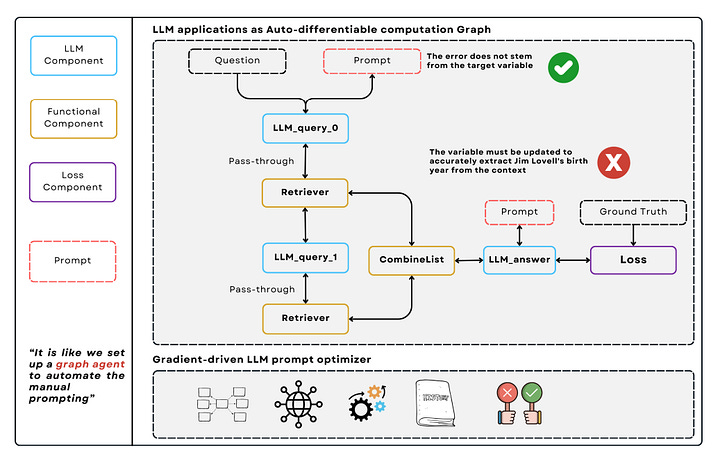
- If you have labeled data: use AdalFlow's LLM-AutoDiff to automatically tune your PROMPT and DEMOS for higher accuracy/F1 with full observability.
- If you lack labels: use Output-vs-Output (OvO) self-supervised prompt battles. A separate judge model picks winners—no ground truth required, so the prompt gets stronger over rounds.
- Best of both: pretrain a good base prompt with OvO on unlabeled data, then fine-tune that prompt (plus auto-bootstrapped few-shot demos) with AdalFlow on a small labeled set for faster convergence and lower cost.
Who Is This For?
- ML/LLM engineers who want practical, cheap accuracy gains without a huge labeling campaign.
- Product teams that need observable tuning and versioned artifacts (prompts/demos/metrics).
- Researchers evaluating self-play style prompt optimization.
Two Optimization Paths
Path 1: AdalFlow LLM-AutoDiff (Supervised)
- Goal: Auto-optimize PROMPT and DEMOS against validation metrics (accuracy, F1).
- Mechanics: Treat prompts/demos as parameters; define metrics; run LLM-AutoDiff; get observability and reproducibility.
- Use when: You have at least a small labeled set and you want stable, auditable improvements.
Path 2: Output-vs-Output Self-Supervision
- Goal: Make progress without ground truth; a judge model chooses winner between two outputs (A vs B).
- Mechanics: Candidate prompts fight on small batches; judge picks winners; we mutate the winner to produce the next generation; early-stop, debias, and cap costs.
- Use when: Cold start on mostly unlabeled data, to get a solid P₀ (base prompt) before supervised tuning.
Why Combine These Two?
In real life there usually is a little labeled data and a lot of unlabeled data.
- Only supervised → slow cold start, costly labeling.
- Only self-supervised → weaker guarantees, harder to validate for prod.
The hybrid plan—faster convergence, better metrics, and lower token spend:
Run OvO self-supervision first to forge a stronger base prompt (no labels needed), Feed that base prompt as a PROMPT initialization to AdalFlow and add a few few-shot DEMOS (auto-bootstrapped from high-confidence OvO outputs) to do LLM-AutoDiff on a small labeled set.
Conclusion
This dual-engine recipe lets you pre-train a strong base prompt with OvO self-supervision (no labels, low cost) and then finish with AdalFlow's LLM-AutoDiff on a small labeled set to lock in stable, observable gains. Treat PROMPT and DEMOS as first-class, trainable parameters; initialize them from OvO; and version everything. In practice, this combo reduces iterations, controls token spend, and yields a self-improving classifier you can confidently ship.